

This is the question we get asked more than any other. "What's the difference, really?" Or: "Is crystal worth it, or is glass fine?" Or, increasingly: "Can I just go acrylic and save the money?" Here's the honest answer, with five minutes of facts to back it up.
The five-second answer
If you only read one paragraph: optical crystal for the moments that matter most, glass for the bulk of corporate recognition work, and acrylic when budget is the binding constraint or you need full-color logos. The price spread is roughly 1:3:6 — acrylic at the bottom, crystal at the top. Weight follows the same curve. The rest of this article unpacks why.
1. Optical Crystal
Optical crystal is high-clarity, lead-free glass with a refractive index high enough to bend light like a prism. It's the heaviest, clearest, and most expensive of the three. A typical 8" piece weighs four to seven pounds — heavy enough to feel like an artifact, light enough to ship economically.
Optical crystal is what you choose when the recipient will keep the award on their desk for the rest of their career. Senior-executive retirements. Lifetime achievement honors. "Hall of Fame" moments. The cost reflects the moment: typical retail runs $150 to $500 for a finished 8" piece.
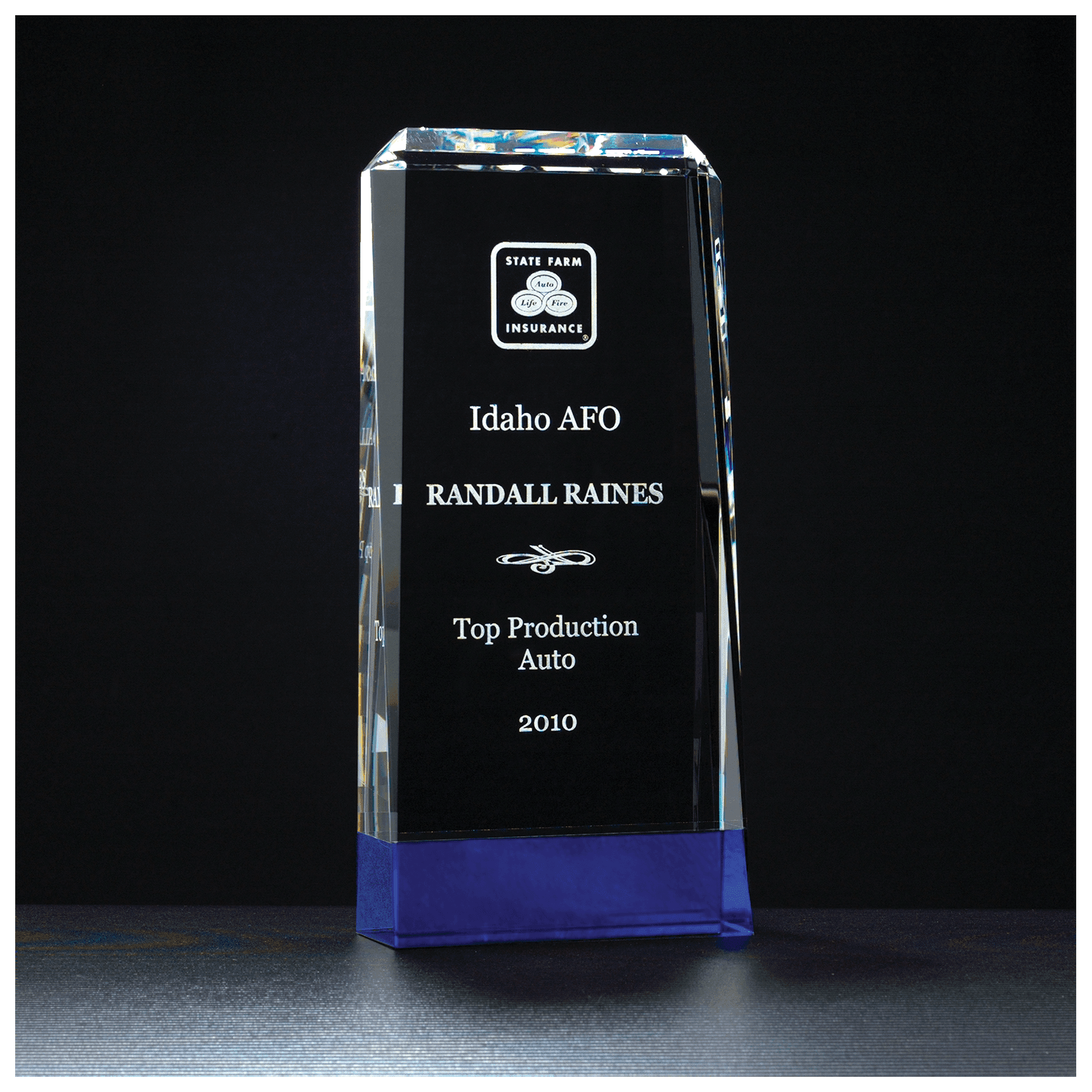
Engraving on crystal happens two ways. Surface engraving etches the front face — a clean, classical look that reads beautifully across a room. Subsurface 3D laser engraving places a floating image inside the block. Subsurface is dramatic at first glance but makes long inscription text hard to read. For most recognition awards, front-face surface engraving is the right call.
2. Glass
Glass is the workhorse of corporate recognition. Less expensive than crystal, lighter, visually clean — typically with a green-tinted edge (called jade glass) or fully clear. A typical 8" glass piece weighs two to four pounds. The look is elegant without being heroic.
Glass is the right choice when you're producing in volume: service anniversaries, sales recognition cycles, perpetual awards that get re-engraved every year with the new winner's name. Retail typically lands $50 to $200.
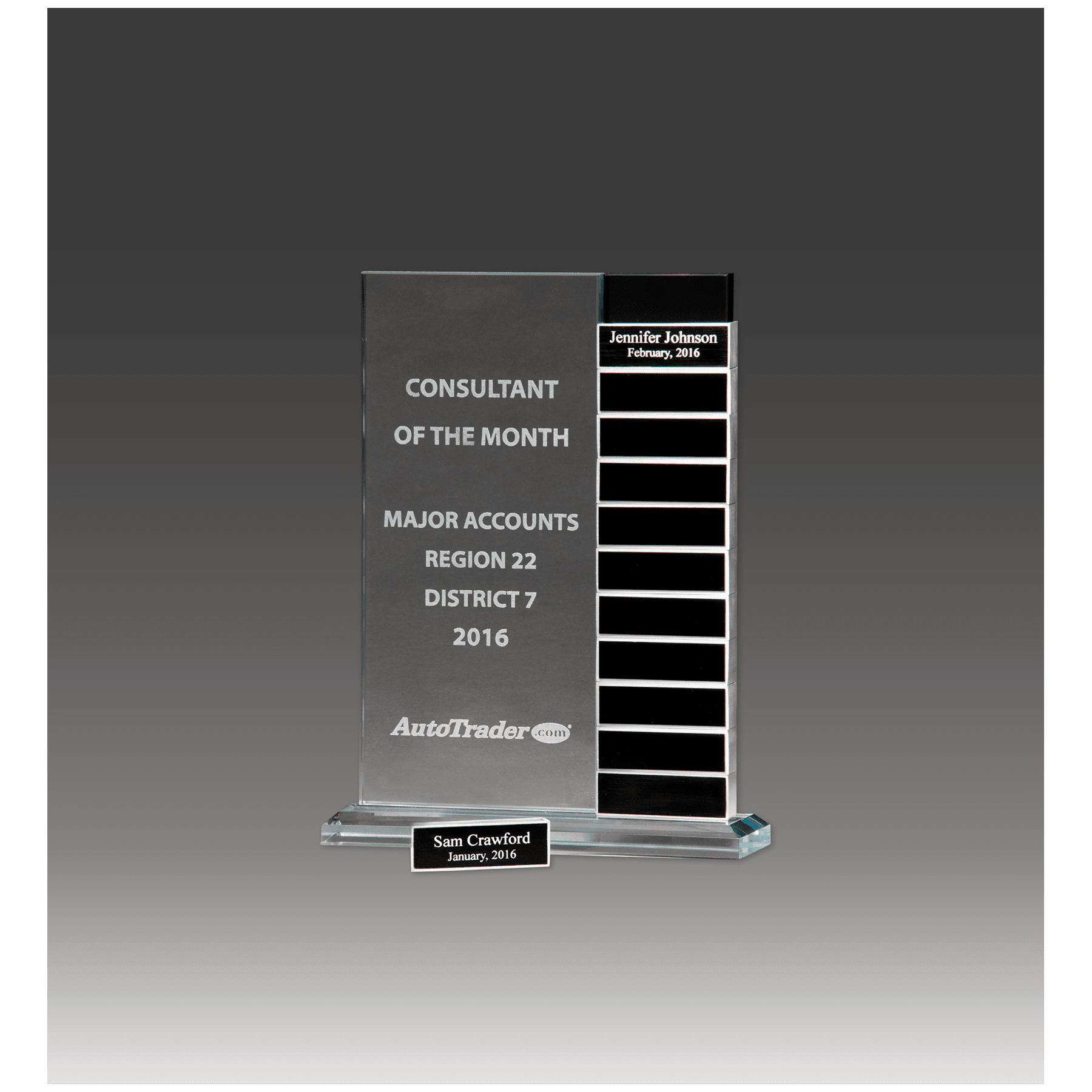
The deep emerald tint at the edges of jade glass comes from how the glass is poured, not from a surface coating. It won't fade. The engraving cuts a frosted line into the surface that contrasts beautifully against the dark of whatever the piece is sitting on.
3. Acrylic
Acrylic is the modern, lightweight, full-color option. A typical 8" acrylic piece weighs half a pound to a pound and a half. It looks bright and clean on a shelf. Importantly, it is the only one of the three materials that can carry full-color printing — gradients, photographs, exact-Pantone brand logos, all baked into the piece during fabrication.
Acrylic is the right call for high-volume programs (300 quarterly performer awards, for example) where the unit budget is $30 to $150 and the logo is the visual hero. It's also the standard for tech companies and start-ups whose visual identity leans modern.
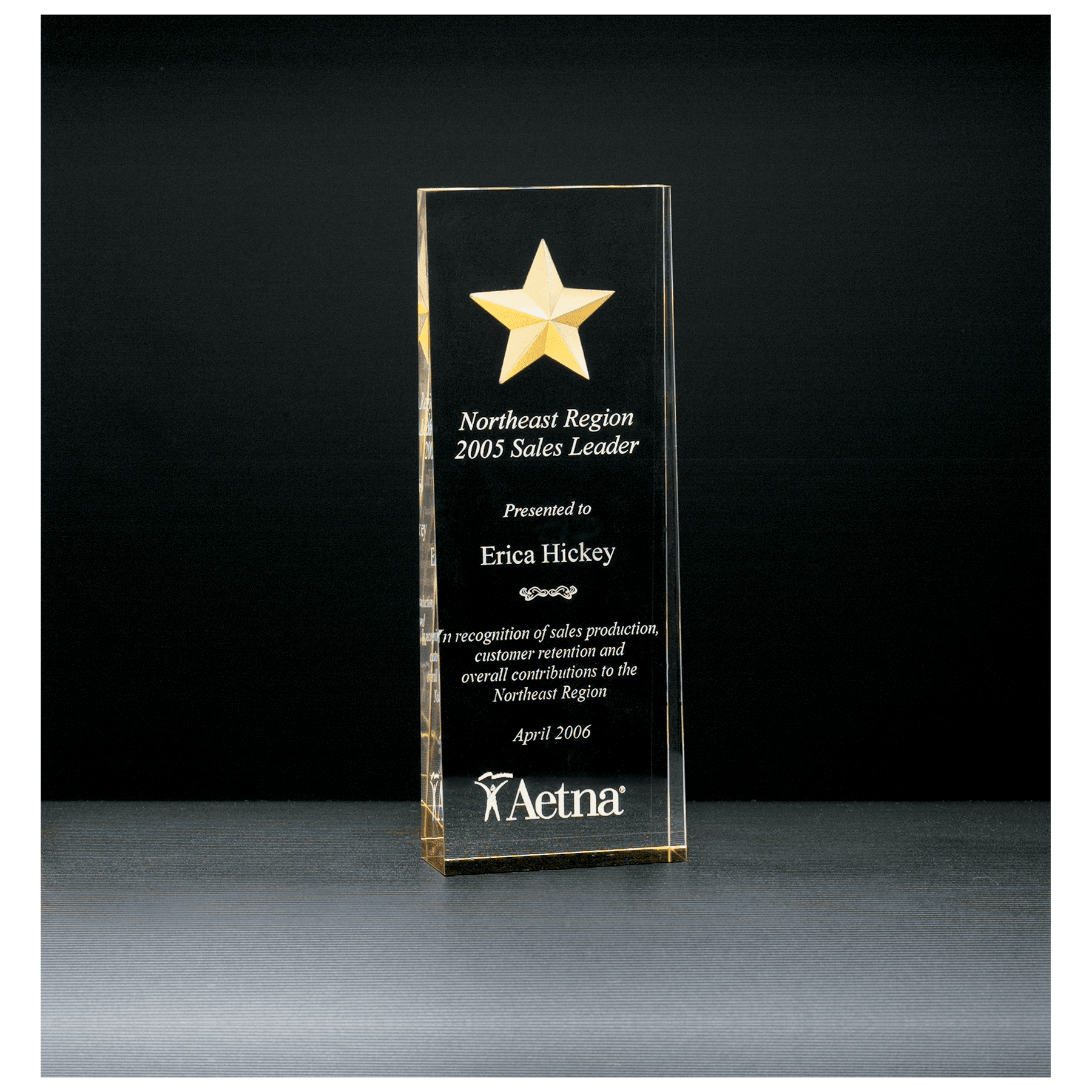
Two real downsides to know about acrylic: cheap material can yellow over many years of direct UV exposure, and the surface scratches more easily than crystal or glass (see sidebar). Both have fixes — use UV-stable acrylic (everything we stock is) and don't park it in a south-facing window for fifteen years.
Side-by-side: the spec sheet
The full comparison, distilled to the seven facts that actually matter:
| Optical Crystal | Glass | Acrylic | |
|---|---|---|---|
| Avg. weight (8" piece) | 4–7 lb | 2–4 lb | 0.5–1.5 lb |
| Clarity / light play | ★★★★★ | ★★★★ | ★★★ |
| Scratch resistance | ★★★★ | ★★★★ | ★★ |
| Engraving depth | Surface or 3D inside | Deep surface | Surface only |
| Full-color logo | No | Limited | Yes |
| Typical retail (8") | $150–$500 | $50–$200 | $30–$150 |
| Lifespan, cared for | Decades | Decades | 10–20 years |
There is no "best" material. There is only the right material for who is receiving it and where it will live.
— 45 years of saying this
The honest recommendation
If we had to put it in one sentence: buy as far up the material curve as the moment justifies, and not one step further.
A new sales rep hitting their first quarterly target does not need optical crystal. Acrylic with a clean engraving looks great on their desk, costs the program twenty percent of what crystal would, and signals exactly the right amount of fanfare. A CEO retiring after thirty years should not be handed acrylic. They have outlasted three CFOs and a leveraged buyout. Crystal — or, if budget is tight, a substantial piece of glass with a multi-line inscription and dates.
If you're in the middle and aren't sure: glass. It is the safest answer for eighty percent of corporate use cases. Less risky to over-spend on, less risky to under-deliver with. The market has spent decades arriving at this conclusion, and they're not wrong.
One last thing — material is half the decision. How to choose an award (without overthinking it) covers the recipient and occasion side. Read them back-to-back if you have fifteen minutes.